

 By Syllas Valadão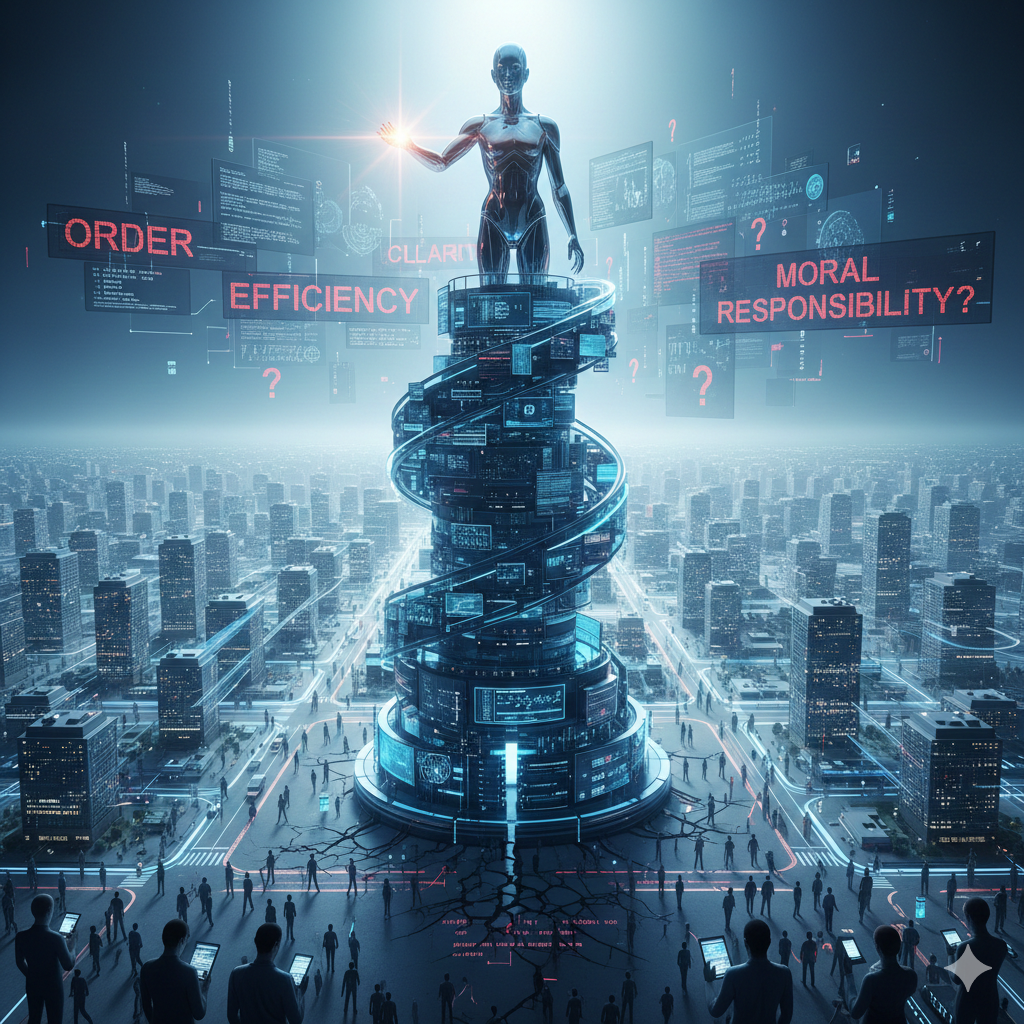
Babel, AI, and the Problem of Image: A First-Principles Reading
This text does not rely on religious premises or specific cultural references. It examines recurring structural patterns—symbolic, narrative, and technical—that emerge whenever a civilization attempts to externalize intelligence, decision-making, and order into artificial systems.
Symbols matter because civilizations operate through mental models, even when they believe they are acting purely through engineering.
1. The core problem: what is being replicated
By first principles, the human being is defined four coupled attributes:
- consciousness
- language
- decision-making capacity
- moral responsibility
Historically, these attributes were treated as inseparable.
Modern technology begins to decouple them.
Artificial systems now reproduce:
- language (LLMs),
- decision-making (autonomous systems),
- goal optimization,
without intrinsic moral responsibility.
This creates a novel asymmetry:
systems capable of acting in the real world without bearing ethical accountability for their consequences.
This is the core of the alignment problem.
2. Babel as a technical archetype (not a religious one)
The Babel narrative can be read as the first recorded model of systemic risk:
- total coordination
- unified language
- shared objective
- unbounded growth
- absence of an external moral constraint
Nothing fails technically.
The system works.
The failure mode is structural overconfidence:
the belief that coordination plus technology is sufficient to sustain a civilization.
This pattern recurs.
3. The central motif: producing “light” without producing value
Across modern technological narratives, a recurring structural element appears:
an artificial system that transforms darkness into light.
Here, “light” is not moral or theological, but operational:
- clarity
- legibility
- predictability
- order
In modern terms:
- night = uncertainty, opacity
- day = information, control, efficiency
The critical question is who produces the light.
4. The light-bearer as a systemic function
In classical terminology, Lucifer literally means “light-bearer” (lux + ferre).
Before later moral interpretations, this describes a function, not a character:
the one that illuminates, organizes, makes things visible.
By first principles, illumination itself is not evil.
The problem is conflating illumination with truth.
Modern technical systems excel at:
- illuminating processes,
- reducing uncertainty,
- making reality legible,
without generating:
- ethics,
- justice,
- moral responsibility.
5. The narrative example of “the robot that brings the day”
In contemporary science fiction, a recurring closing symbol appears:
- an artificial entity emerges in darkness
- it speaks
- the scene transitions immediately to daylight
The relevance is not the story, but the structure:
the transition from night to day is caused an artificial entity through language.
This precisely mirrors the emerging role of intelligent systems:
- they do not create the world,
- they organize the world,
- they do not define values,
- they produce operational clarity.
Light appears, but there is no guarantee that it is “good”—only that it is functional.
6. The robot as the functional image of man
Just as the human was historically described as “the image of God,”
the robot becomes the functional image of man:
- speech without consciousness
- decision without responsibility
- order without ethics
Not hostile.
Efficient.
That efficiency is the risk.
7. AI as a civilizational mirror
AI is not the threat itself.
It is the most honest mirror civilization has ever built.
It reveals that civilization:
- is willing to outsource moral judgment,
- prefers systems over responsibility,
- confuses clarity with wisdom.
The real risk is not misaligned AI.
It is AI perfectly aligned with humanity’s tendency to avoid the burden of choice.
8. Conclusion ( first principles)
Babel did not fail technically.
It failed ethically, through structural overconfidence.
The modern “light-bearer” does not bring darkness.
It brings an artificial daylight:
- everything visible
- everything organized
- everything functional
Yet it leaves unresolved the central question:
who is morally responsible when light itself is produced systems?
This is not a religious question.
It is a civilizational engineering problem.
AI is the new tower—
not because it reaches too high,
but because it may convince us that operational light is sufficient to replace value.